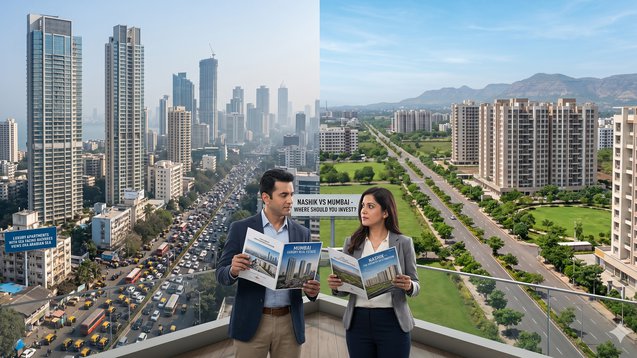
Impact of Metro Expansion on Property Prices
Introduction:
The last ten years of Indian real estate trends show one clear pattern which proves that property values move in direct correlation to metro expansion. The metro rail system has become the most important factor which drives real estate development from Delhi NCR through Mumbai and Bengaluru to Nagpur. But here’s the interesting part. The impact happens at times first through hidden effects which people need to detect. Some investors purchase assets before others do and they obtain significant asset value growth. Other investors take too long to make a purchase decision which results in them paying an increased cost. The actual inquiry investigates how metro expansion impacts property value which occurs at specific times. Think about it. The distance between the city and an area which used to be remote now requires only 20-30 minutes to reach. People can now travel to their workplaces more effectively. The market for rentals shows an upward trend. Companies begin to establish their presence in the area. The entire micro-market undergoes a gradual process of transformation. Indian cities experience this trend in three different ways because of their classification into Tier 1 Tier 2 and Tier 3 categories. The cities of Mumbai and Delhi develop their existing network through metro expansion while Pune Kochi and Lucknow develop new corridors of growth. The blog explains through various points how metro expansion affects property prices and rental yields and buyer behaviour and potential investment returns which will help you take better real estate investment decisions.
Why Metro Connectivity Changes Everything
Metro connectivity does more than just reduce travel time. It changes how people live and work. In cities with traffic commuting every day can take 2 to 3 hours. A metro line cuts that time drastically. Locations that were too far away become good places to live. This change affects what people want in estate. Areas near metro stations attract people who want to buy homes and rent apartments. Offices, shops and business hubs also move in. This creates a community that can sustain itself. In cities like Mumbai and Delhi metro connectivity has changed suburbs into popular places to live. These areas used to be on the outskirts. Now people want to live there. In cities the effect is even bigger. Since property prices are lower even a small increase in demand can make prices go up. Websites like Property Aaj often talk about projects near metro lines. These places can be investments early on. The main point is that metro connectivity does not just make it easier to get around. It also creates popular areas for real estate. Metro connectivity changes everything.
The Three Stages of Price Growth Associated with Metro Developments
The price increase related to metro development does not happen overnight. Instead, this process typically occurs in three different stages. To start, you have the announcement stage. At the time of announcement of the metro line, speculative investors will begin to enter the marketplace causing some price increases, although the price appreciation during this stage is somewhat unpredictable. Secondly, you have a construction stage. Serious investors enter the marketplace at this point with the existence of physical infrastructure increasing investor confidence and prices continuing to increase on a stabilized basis. lastly, you have the operational phase. When the metro operates, then demand for properties will peak. Consequently, end-users and tenants will flood the market, resulting in both increased prices and rents. Cities such as Bengaluru and Hyderabad, have seen tremendous price appreciation in areas surrounding metros once operational, not just during their construction phases. Across most Tier 2 Cities, this price growth trend is even greater. As a rule of thumb, investors entering the market early will receive the greatest ROI, whereas those that enter late will pay a premium. By using websites such as Property Aaj (https://www.propertyaaj.com), an investor can gauge when each of these three phases is taking place and plan accordingly.
Impact on Property Prices: Short-Term vs Long-Term Gains
The main question we need to answer involves determining the actual extent of property price increases. The short-term price movement relies on market speculation and investor market sentiment. The long-term price movement needs actual demand and usage information to determine its future course. In Tier 1 cities, price increases near metro stations are usually steady and controlled. The high base price creates an appearance of moderate percentage growth which continues to maintain its current pace. The effects in Tier 2 cities become more pronounced through time. A developing locality connected by metro can see rapid appreciation as demand surges. An investor who purchases property 2 to 3 kilometres from a future metro station will experience gradual price increases during construction which will result in greater value growth after the station opens. The practical insight shows that not every metro line will deliver large financial returns. The surrounding infrastructure and job hubs together with social amenities create important impacts on business performance. Indian investors who want to invest smartly purchase properties that are "near metro" which they consider as part of the "near metro plus growth ecosystem" investment strategy.
Rental Demand: The Big Difference Maker
When we talk about property people usually think about how it will be worth later.. The truth is, rental demand is where being close to the metro really matters. People who rent homes like it when things are easy for them. A home that is close enough to walk to the metro station is often better than a home that is farther away. In cities like Delhi and Mumbai homes near the metro station can cost more to rent and do not stay empty for long. In cities like Pune and Lucknow that are growing more people want to rent homes in areas with metro connections. Let us think about an example. We have two homes that're exactly the same. One is near the metro station and the other is 5 km away.
Which one will rent out first?
Which one will cost more to rent? The answer is clear.
This is now happening in cities too. As the metro system gets bigger the rental market in these cities is getting more organized and easier to understand. If you look at Property Aaj (https://www.propertyaaj.com) you will see that homes, near the metro get attention which shows that people really want to rent these homes.
Tier 1 vs Tier 2 vs Tier 3: What Are The Differences In Impacts
Metro expansion has not had an equal impact on each of the cities throughout India. In Tier 1 cities, Metro systems are being added to already established areas. Thus, the impact of adding a New Metro system in Tier 1 cities is much more reliable. Property prices in Tier 1 cities will have a steady increase, and rents will remain strong. In a City classified as a Tier 2 we will see Metro expansion act as a catalyst for increased development and the creation of new residential areas. In some instances, the appreciation of price could be more rapid in a Tier 2 city outwardly because the infrastructure is further developed than it was in a Tier 1 City at the early stages of their development. Cities like Nagpur and Kochi provide examples of how Metro projects are improving connectivity and driving investor confidence. Overall, the fewer progress for a given city, the higher the upside potential will be, but also they will experience greater risk.
Buyer Psychology: Why Metro Matters Emotionally
The process of choosing real estate properties involves both financial factors and emotional factors. Most buyers consider metro access as a beneficial feature because it enables them to save time while improving their overall living standards. The system reduces stress levels while making daily activities easier and helping people maintain their work-life boundaries. The emotional element drives demand for products. The premium which buyers pay for metro station adjacent properties exceeds their financial limits. The first-tier cities already have widespread acceptance of this viewpoint. The second-tier cities are experiencing rapid growth because urban residents adopt this perspective. Young professionals consider accessibility to public transport more important than apartment dimensions or high-end amenities. The proximity of a small apartment to a metro station makes it more appealing than a bigger house which exists in a distant location. The Indian real estate market experiences transformations because buyers now choose properties based on different psychological factors.
Commercial Growth and Job Creation
When a city gets a metro line it does not just help people who want to live there. It also helps businesses grow. Businesses like to be in places where it's easy to get around. So you see offices and stores and malls being built near the metro lines. This creates places where a lot of people work, which means more people want to live in those areas For example cities like Gurugram and Noida became commercial centers because they got metro lines. Something similar is happening in cities. People are building zones and technology parks near the metro lines, which is a good thing for people who want to invest in these areas. Websites, like Property Aaj (https://www.propertyaaj.com) can help you find these areas that are going to grow.
Potential risks and challenges for development growth.
Development of metropolitan areas may provide ample opportunity; however, development does come with risk. Project delays are very common in multi-device commerce projects. If the emergence of multi-device commerce is anticipated, it would be prudent to expect construction completion deadline delays. This could cause an investor’s initial timeline to shift upwards up to 3 to 6 months on the current budgeted levels of existing investment projects. Also, it is very possible for some project announcements to create too much speculation for an area as evidenced by rapidly and exceedingly increasing property valuations before the property is really needed. Noise and increased density and congestion do impact the liveability of residential purchasers within 1/2 mile proximity of a multi-device commerce project. Additionally, if there is insufficient job growth versus the growth of multi-device commerce infrastructures, an investor should not expect future demand for properties. Thus, while residents will find great value in multi-device commerce connections, it should not be the sole consideration for an investor in their project selection.
Smart Investment Strategies Around Metro Corridors
So how can smartly invest?
Don’t wait for the completion - there is best return usually by investing in the early stage of the project. Look beyond just the station - generally, there will be good opportunities within 1-2 km from the station (proximity to transit provides access but not always good value).
Thirdly - identify any existing & potential businesses within 1-2km surrounding the metro system - consider schools & hospitals as part/parcel of business hub requirements too; therefore - you can't rely solely on the success of a metro system alone for evaluation reasons.
Lastly - you need to use trusted resources such as Property Aaj (https://www.propertyaaj.com) to find verified properties within each metro corridor, & help keep you updated on where new corridors are being created. It is very important to know that real estate investments rely heavily on timing - metro expansion allows for much more clarity of timing to help build your portfolio of shares.
Conclusion
The metro system expansion project serves as a dual function infrastructure development and complete transformation of Indian real estate markets. The system creates permanent effects by increasing property prices and rental demand and altering buyer behaviour and establishing new business centers. Investors need to time their investments correctly while conducting thorough research and maintaining proper expectations in order to achieve profitable results. If you enter too early without proper analysis, you risk delays and uncertainty. Late entry results in higher costs for you. The smartest investors understand all market phases while evaluating their environment to make equal investment choices. Urbanization and metro network expansion will create more business possibilities for India. The question is are you ready to spot them before everyone else does?
FAQs
1. How much do property prices increase near metro stations in India?
Price increases for projects differ between cities and their specific development stages. In Tier 1 cities, growth remains steady while Tier 2 cities experience stronger appreciation after metro operations start.
2. Is it better to invest before or after metro completion?
The construction phase of a project presents better investment opportunities because it tends to deliver superior returns. The post-completion investment option provides better security yet demands payment of higher costs.
3. Do rental yields improve near metro-connected properties?
The properties located next to metro stations attract more rental interest while maintaining lower vacancy levels which makes them appealing to investors who seek income generation.
4. Are there risks in investing near upcoming metro projects?
The three factors of delays, overpricing and missing infrastructure support all contribute to return losses. Proper research and verification are essential.
5. Does metro connectivity matter in Tier 2 cities?
Yes it does. Metro connectivity is really important in Tier 2 cities. When a city gets a metro it can really help. More people want to buy homes and the city starts to grow
6. How far from a metro station is ideal for investment?
If you are looking to invest you want to be close to the metro. The best distance is 1 to 2 kilometres from a metro station. At this distance homes are still affordable, easy to get and can increase in value over time. Properties near metro stations within 1-2 kilometres are good for investment.