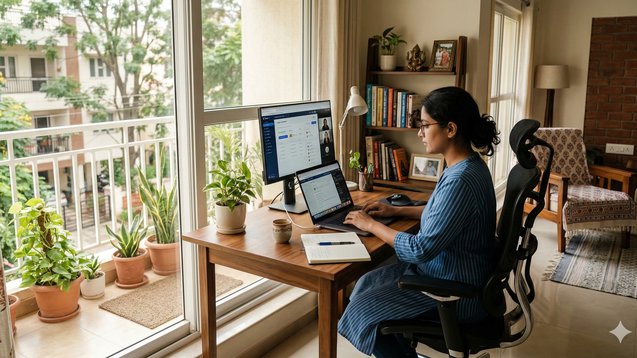
Introduction: Remote Work Has Changed What "Perfect Home" Means
Homebuyers in India used to select homes based on their distance from office hubs and metro stations and business districts. The current situation exists because remote and hybrid work systems became normal work practices in IT and consulting and design and finance and government-related positions. The definition of an ideal home has changed because people now work at home. A home serves remote workers as their primary location for work activities which includes their required rest periods. The space has evolved into a combined office and meeting area and creative workspace and efficiency centre. Remote professionals are moving to Tier 1 cities like Bengaluru and Mumbai and to Tier 2 cities which include Indore and Coimbatore and to Tier 3 cities because they provide better living conditions at lower costs. This situation creates problems for many home purchasers. The residents of this house chose their home according to traditional home selection criteria which resulted in them experiencing problems with loud sounds and weak internet connections and insufficient space and inadequate areas for work. Your property assessment on Property Aja (https://www.propertyaaj.com) requires you to analyse properties through a remote-work perspective. This guide will explain which home types best suit remote workers in India while assisting you to select properties that will meet future demands.
Why Remote Workers Need a Different Home Selection Strategy
The process of working from home appears simple to people who have not experienced its actual challenges. The combination of video calls and household sounds creates difficulties. The limited area causes cognitive exhaustion. The meeting process gets interrupted by insufficient internet connections. The small problems which occur during work time will develop into major challenges for both productivity and work-rest periods after extended time periods. Traditional Indian homes were designed to accommodate family living spaces which functioned as their primary purpose while lacking spaces that met actual professional needs. The design of compact apartments in Tier 1 cities focuses on achieving maximum unit density throughout their entire building area. The Tier 2 and Tier 3 cities provide space availability conditions which differ from the planning and infrastructure quality standards which exist in different areas.
Remote workers must evaluate homes through three critical lenses: workspace comfort, digital infrastructure, and lifestyle sustainability. The housing requirements of a software developer who works night shifts in the US differ from those of a freelance designer who works at various times throughout the day. Property buyers who visit Property Aaj (https://www.propertyaaj.com) search for properties using room layouts and balcony measurements and society facilities as their main criteria instead of using location as their main filter. The new behaviour pattern which people exhibit will continue to exist without any changes. Your income depends on your home workspace, so you need a property that meets both your work requirements and your home living needs.
2BHK Apartments with a room for studying: this is what most people want
For people who work from home in India a 2BHK apartment with a room for studying is the best option. It is affordable and easy to take care of. It has enough space for everything. In cities like Bengaluru, Pune and Hyderabad builders are making 2BHK apartments with a special area for studying. These apartments have spaces that can be used as an office. They are expensive. They are well designed. In cities like Nagpur, Jaipur and Lucknow people can buy 2BHK apartments with more space and they are cheaper. This means people who work from home can have an office in their home without spending too much money. The way the apartment is laid out is more important than how big it is. A 2BHK apartment that is not well planned can feel small. When you look at apartments, on Property Aja (https://www.propertyaaj.com) look at the floor plan. Not just the size. For people who get a salary and couples who work from home, 2BHK apartments are the best because they are affordable and useful and can be sold easily.
3BHK Homes for Dual-Remote Working Couples
The 3BHK configuration proves to be more useful for urban Indian couples who work from home because both partners currently work from home. The explanation starts from this point. The shared space becomes difficult to manage when two professionals need to use video equipment at the same time. The team members experience daily anxiety from three main problems which include background sounds and their need for privacy and the difficulty of finding a common meeting time. The third bedroom provides an ideal solution because it enables people to establish distinct workspaces for their activities. In Tier 1 cities, the jump from 2BHK to 3BHK pricing can be steep. In peripheral micro-markets and emerging corridors, the pricing difference between 2BHK and 3BHK becomes easier to manage. The price difference between 3BHK homes and other houses remains affordable for remote-first families in Tier 2 and Tier 3 cities. The long-term benefits include. The demand for bigger houses has increased because of remote work becoming a permanent office practice, which results from changing buyer preferences that emerged after 2020. The property area will experience growth because of the increased demand for rental spaces which will improve the property's resale value. A 3BHK home becomes necessary for remote workers as their work demands increase, which makes it more valuable than a luxury item.
Independent Houses: Ideal for Privacy and Long-Term Remote Careers
Independent houses provide remote workers who need permanent or long-term remote work solutions with their most beneficial option when they select their residential locations correctly. The biggest benefit is control. You control noise levels, workspace customization, renovation flexibility, and future expansion possibilities. The flexibility of this system enables home-based freelancers and consultants and YouTubers and start-up founders to deliver better work results.
In Tier 2 and Tier 3 cities, independent homes remain relatively affordable compared to metro markets. Remote workers are moving to Mysuru and Nashik and Bhubaneswar and Vadodara because these cities offer them more affordable living expenses and larger residential spaces. Infrastructure evaluation requires buyers to proceed with careful assessment. Different areas of the city show significant differences in both dependable broadband service and power backup systems and civic development progress. You should verify all connectivity options before making any decisions about your research through Property Aja (https://www.propertyaaj.com). People who plan their future with independent homes, as their best choice, who want to maintain their private spaces through their choice of personal design, and who require a stable way of living, should make this selection.
Gated Community Apartments: The Work-Life Balance Advantage
Remote work can create challenges that lead to social isolation. Gated communities provide a hidden benefit which most homebuyers fail to recognize. Modern gated societies in India now include co-working lounges, landscaped open spaces, walking tracks, clubhouses, and cafés within the premises. The amenities provide remote workers a way to escape their daily routines while maintaining their psychological health.
In Tier 1 cities, premium gated communities charge higher rates which lead to increased rental demand and property value appreciation. In Tier 2 cities, the value proposition becomes more appealing because buyers receive greater space and better amenities at lower prices. Another hidden benefit is power backup reliability — a critical factor for professionals attending frequent video meetings. Many standalone buildings still struggle with consistent backup systems. Remote workers who value community living and security should consider well-managed gated projects which Property Aja lists at https://www.propertyaaj.com.
Studio Apartments: Best for Solo Remote Professionals
Young remote workers and digital nomads and early-career professionals show growing interest in studio apartments. The apartments provide affordable living which requires minimal upkeep and offers good availability across metropolitan areas. The apartments present two different value propositions to residents.
Studios within Tier 1 cities exist as high-density micro-market spaces. The area provides strong connectivity and high rental demand but its limited space creates mental strain on remote workers who work from home. What feels efficient initially may start feeling restrictive after six months of continuous home-based work.
The studio supply in Tier 2 cities has not reached full capacity but it continues to expand towards educational and IT centres. The pricing structure presents a compelling value proposition yet the market lacks stable resale demand.
Studios work best for:
Single professionals
Short-term remote workers
Investors targeting rental income
But for long-term remote careers, most professionals eventually upgrade to at least a 2BHK. Think carefully before committing.
Peripheral Suburban Homes: The Rising Remote Work Trend
The Indian housing market has experienced its most significant post-pandemic transformation through the emergence of suburban and peripheral micro-markets. Remote work has decreased the requirement for employees to reside within 5-8 kilometres of their workplace locations. Homebuyers in Bengaluru and Hyderabad and Pune and Delhi NCR are relocating their homes 15-30 kilometres away from city centres to obtain larger residences at more affordable rates. The trend demonstrates even stronger effects in Tier 2 cities where infrastructure development progresses at a high speed. Three key benefits suburban areas provide remote workers include increased living space and superior environmental conditions and cost-effective options. Future mobility requirements need to be considered when making this decision. Hybrid work policies can still require occasional office visits. Evaluate upcoming infrastructure projects and highway connectivity and metro expansion plans before making your final decision. Property buyers on Property Aaj (https://www.propertyaaj.com) have already started to choose future growth corridors as their main focus instead of only considering existing popular locations.
Legal and Financial Factors Remote Buyers Often Miss
Remote buyers must conduct legal and financial due diligence after they select their preferred home type. The risk of mistakes becomes more likely because remote workers need to move between different cities and states. Different states maintain distinct RERA compliance requirements which result in different approval periods between Tier 1 locations and smaller markets. The registration and stamp duty fees in India experience extensive variations which impact the total cost of property acquisition. Home loan eligibility is another key factor. Lenders observe different income stability patterns for freelancers and remote consultants compared to regular employees. Your income structure needs pre-approval clarity at the beginning stage of your application process. You must verify society bylaws before establishing a home office in gated communities. Most residential use cases are permitted, but commercial activities may have restrictions. A smart property decision requires more than floor plan analysis because it demands assessment of two factors: legal status and financial security.
Conclusion: Choose a Home That Supports the Way You Actually Work
Remote work has become a permanent aspect of work life. The new work style has changed how people buy homes and how developers build properties and how housing markets operate throughout India. Outdated beliefs about home selection still lead many buyers to make wrong choices about their future residences. The best home type for a remote worker depends on your work intensity, household size, career stability, and long-term plans. A solo freelancer may thrive in a smart 2BHK, while a dual-income remote couple may find a 3BHK indispensable. The most beneficial option for an entrepreneur establishing a permanent home office requires them to work from an independent house. The key to success depends on reaching a state of alignment. Your home needs to provide support for your workflow requirements and mental well-being and future development needs. The property will disrupt your work schedule which makes it impossible for you to handle your daily tasks because the property creates operational difficulties. The future of remote work in India will evolve as buyers select properties through strategic assessments on Property Aja (https://www.propertyaaj.com) which allows them to make better future-proof choices. You should choose your home based on how you will live and work for the next five years because it will affect your daily life.
FAQs
1. Which home size is best for remote workers in India?
The optimal workspace solution for most professionals requires a dedicated work area inside a 2BHK home that has been designed for efficient living. The 3BHK home provides essential work-from-home privacy needs for two people who need to work from home throughout the day.
2. Are Tier 2 cities better for remote homebuyers?
The answer is yes for most situations. Tier 2 cities provide bigger homes at more affordable rates which enhances the quality of living in those areas. The buyer should confirm broadband service quality and power backup systems and social facilities before completing the purchase.
3. Is buying in the suburbs a good idea for remote workers?
Suburban homes provide excellent value because they offer multiple spatial advantages. You should confirm future connectivity because your company might adopt hybrid work models. You should assess metro plans and highway systems and employment centres before making your decision.
4. Do gated communities help remote professionals?
They often do. The combination of co-working spaces and power backup systems and peaceful environments enables users to work more efficiently while maintaining their mental health. The properties create better resale and rental possibilities which are beneficial to most markets.
5. Should freelancers buy property differently than salaried employees?
Freelancers need to evaluate their income stability and loan eligibility together with their emergency funds. Home loan pre-approval should be obtained at the beginning of the buying process because it helps buyers maintain control throughout the entire procedure.
6. Is a studio apartment suitable for long-term remote work?
Studios work for short-term or single professionals but may feel restrictive for full-time remote careers. Most long-term remote workers eventually prefer at least a 2BHK for better separation between work and personal life.