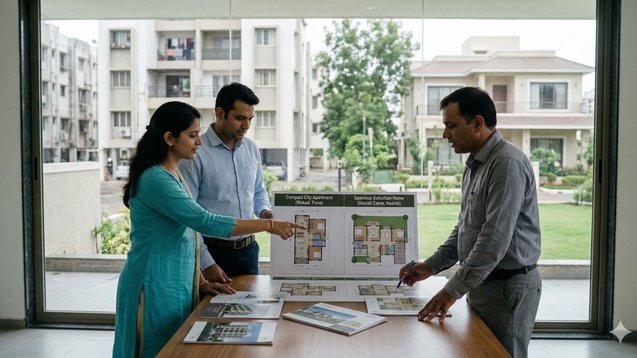
Introduction: The Property Decision That Shapes Your Next Decade
The process of purchasing a house in India requires more than just a straightforward real estate deal. The process encompasses emotional elements and financial aspects while determining how life objectives will be achieved. Homebuyers commonly experience a silent problem which they struggle to express at all times. The challenge requires people to decide between purchasing a house which meets their current lifestyle needs or choosing a property which matches their future five to ten year life goals. The question has become more pertinent because residential properties today experience active market movement. Indians have developed new homeownership patterns because they experience infrastructure growth and workplace changes and property prices increase throughout Tier 1 Tier 2 and Tier 3 cities. A decision that feels comfortable today may feel limiting tomorrow — and vice versa. Some buyers prioritize making comfortable and affordable purchases right away. Some buyers develop their immediate needs into future family planning requirements and forthcoming professional changes and new investment possibilities. The two methods become effective when people select them with awareness of their choices. The guide provides users at Property Aja (https://www.propertyaaj.com) with a method to achieve equilibrium between their current needs and their long-term future requirements. The system ensures your home remains useful to you beyond the initial excitement of purchasing.
Understanding the "Buy for Today" Mindset
Indian first-time homebuyers tend to purchase homes that suit their present lifestyles. The logic is simple and often sensible: choose a home that fits your present income, family size, and daily routine without overextending financially. Young professionals in Mumbai, Bengaluru, and Delhi NCR cities show a strong tendency to use this method. Buyers consider property locations near their workplaces to be essential because they want to maintain financial security by selecting affordable EMI payments. A compact 1 or 2 BHK near employment hubs can significantly improve daily quality of life. The buying pattern exists in Nashik, Indore, and Lucknow because Tier 2 cities show lower property costs which give buyers more buying options. Buyers in Tier 3 towns prefer to purchase houses which meet their current family size requirements. The advantage of this strategy provides people with two benefits: financial stability and decreased mental pressure. The risk involves property ownership expiring before the expected time, which happens to most Indian families after they complete five to seven years of residence.
The “Plan for the Future” Approach Explained
The Future Plan Approach The Future Plan Approach is described through its various components. The buyers who take this path spend beyond their financial limits because they need to fulfil their upcoming resource requirements. They make plans for their future needs which include their family expansion needs and their remote work needs and their elderly parents who will require care and their planned property investments which will increase in value over time. In Tier 1 metros people need to buy properties which are located farther from the city centre because they want to access larger homes. People select new developments in suburbs because they expect future metro systems and road improvements and shopping centres to develop in their area. Purchasers who want to invest in upcoming markets should target.
Tier 2 cities because they represent the most beneficial investment opportunities. Homebuyers can afford larger properties today because home prices remain affordable. Long-term investors who expect cities to grow will find.
Tier 3 markets are attractive because they offer land and independent home options. Future readiness brings advantages which may result in higher property value growth over time. The short-term consequence results in financial difficulties because the higher EMI costs lead to longer work journeys. Smart buyers on Property Aja (https://www.propertyaaj.com) weigh both lifestyle and financial resilience before choosing this path.
Price Realities Across Tier 1, Tier 2, and Tier 3 Cities
Your decision between present comfort and future planning according to price dynamics which show different patterns throughout India. In Tier 1 cities property prices remain elevated because well-connected micro-markets maintain high property values. Future purchasing in this area creates a budget challenge which requires buyers to make less expensive choices by selecting less developed regions that will soon receive infrastructure improvements. The most balanced opportunity distribution exists between
Tier 2 cities. The market sees rising prices which enable buyers to purchase larger homes without facing severe financial difficulties. The cities of Coimbatore and Jaipur and Nagpur experience strong end-user demand because their prices remain affordable for middle-class consumers.
Though Tier 3 towns offer minimal entry barriers their property values increase at a slower rate while their infrastructure development process proceeds at an unpredictable pace. The buyers who aim for future property appreciation need to examine both economic factors and active development work on connectivity projects. The different stamp duty rates between states together with the changing home loan interest rates create a direct impact on housing expenses. Proper cost assessment requires you to determine all expenses related to property acquisition before making property acquisition financial commitments.
How Family Planning Should Influence Your Decision
Family planning serves as the most effective framework to assess this issue. Indian households often evolve quickly, and housing needs can change faster than expected. A newly married couple in a Tier 1 city needs a 2 BHK apartment which exists in a prime location today. The couple needs to create a new space plan because they will need school proximity and storage areas when their children arrive within the next few years. The 3 BHK units in Tier 2 cities become popular because buyers want more space than they currently require. The system allows users to maintain their current setup until they need to make an upgrade. Tier 3 buyers often think in terms of expandable independent homes or plots where additional floors can be constructed later. Ask yourself honestly: how likely is your family structure to change in the next 5–8 years? When the probability becomes too high, you should begin planning because it will help you reduce your future transaction expenses. When shortlisting properties on Property Aja (https://www.propertyaaj.com), always visualise how the home will function with one additional family member.
The current trends in workplace operations are producing new outcomes.
The emergence of hybrid and remote work options has brought about major changes to home buying patterns throughout India. Remote work has turned the property which seemed adequate before 2020 into a place which now requires more space because of permanent work-from-home needs. In Tier 1 cities, many professionals are rethinking micro-apartment living because of space constraints. The presence of a tiny workspace area has evolved into a crucial element which people now use when making their selection. The shift has brought major advantages to Tier 2 cities. Buyers who once prioritised metro proximity are now choosing larger homes in emerging cities where space is affordable and lifestyle quality is higher. The job ecosystem strength remains the primary factor which determines whether reverse migration occurs in Tier 3 towns. People should include workspace flexibility in their future planning because their work situation has a moderate chance of developing hybrid or remote work options. The current buyers make one of their most common errors by disregarding this particular trend.
Investment Perspective: Short-Term Comfort vs Long-Term Growth
The investment decision process becomes more complicated because it requires multiple evaluation methods. The home purchase decision for immediate comfort needs to be evaluated because it will affect future property value increases. Central business districts of Tier 1 cities provide properties which generate consistent rental income but fail to produce sudden value increases. The initial difficulties of peripheral growth corridors do not match their eventual performance which delivers higher returns over time. The current infrastructure development in Tier 2 cities combined with corporate relocation activities creates a situation that enables high property value appreciation. The market in Tier 3 areas provides developers with opportunities for rapid growth but it requires extended time frames before they can achieve results. The two groups of buyers exhibit different mental patterns. End users seek out properties which provide comfortable living conditions while investors base their decisions on upcoming infrastructure development plans and job centres. The most effective method combines both elements. Select a property which fulfils your daily requirements while being located in an area with future growth potential. Platforms like Property Aja (https://www.propertyaaj.com) enable users to evaluate end-user requirements together with investment needs through a direct side-by-side interface.
The Financial Stress Test determines whether your budget supports your future planning needs.
The process requires testing before your upcoming readiness assessment for home expansion. Most buyers skip this essential step because they want to purchase a larger home. Your EMI-to-income ratio needs careful evaluation. Financial planners in India recommend that people should keep their total EMIs under 35 to 40 percent of their net monthly earnings. The threshold creates a cash flow challenge that will persist indefinitely after it gets broken. The increasing maintenance expenses need to be included for all property owners in Tier 1 and Tier 2 cities' large gated communities. Home loan rates in India follow a cyclical pattern, so you must include interest rate changes as part of your financial calculations. Tier 3 buyers tend to underestimate how long infrastructure projects will take, which results in delayed property value growth while their EMIs continue. A home that requires less space provides better financial security than a future-oriented investment which creates financial strain.
When It Makes Sense to Focus on Today
There are situations where buying for your current needs makes more sense. If your job path is not clear or you might have to move to a place, being flexible is more important than thinking about the future. This approach often works better for professionals living in big cities. If you think you will earn a lot of money in the next few years, buying a modest home now and upgrading later can be a good plan. If you really value being able to do things every day like not having to commute for a long time, buying with your current needs in mind can improve your quality of life. In cities where things are changing fast, being able to sell or rent your home is also important. Smaller homes, in locations are usually easy to rent out or sell if your plans change. The key is to think about what you want rather than just buying the biggest home you can afford.
When it comes to planning it is the smarter move.
Buying a home with the future in mind makes sense in certain situations. If you have a job and you know your income will grow in a predictable way buying a slightly larger home can be a good idea because you will not need to upgrade as often. If you are buying a home in an area that is growing quickly and has roads and other important infrastructure, planning ahead can help you make money as the area becomes more popular. For families who're sure they will stay in the city for a long time, especially those with kids in school buying a home that is a little bigger, from the start is often a good idea. However it is very important to stretch your budget a little and not try to buy a home that is too expensive.
Conclusion: The Right Answer Lies in Balance
The debate between buying for today and planning for the future does not have a universal winner The smartest Indian homebuyers recognise that the ideal strategy sits somewhere in the middle Your home should provide comfortable space for your present needs while remaining within your financial capabilities The space requires sufficient flexibility to meet upcoming life changes which will happen during the next several years Across Tier 1 metros Tier 2 growth hubs and Tier 3 emerging towns the most satisfied homeowners are those who asked better questions before purchasing -- not just about price but about life trajectory As you explore options on Property Aja httpswwwpropertyaajcom you should evaluate each property through two lenses which include its current value and its future value to you Get that balance right and your home will become more than just a purchase The purchase will bring you benefits which extend for multiple years ahead.
FAQs
1. Is it better to buy a bigger home now or upgrade later in India?
Your decision depends on two factors which are your income stability and your future family development plans. Your future income growth and your low risk of relocation should lead you to purchase a larger property today because it will decrease your future buying expense. Your best option is to begin with a smaller purchase which you can expand through future upgrades.
2. Do Tier 2 cities offer better future growth than Tier 1 cities?
Yes, in most situations Tier 2 cities demonstrate higher potential for future development when compared to Tier 1 cities. Tier 2 cities show higher percentage increases in value because of infrastructure development and because their property values start from lower levels. The rental demand and market liquidity in Tier 1 markets provide better investment opportunities for landlords.
3. How much should I stretch my budget for future needs?
Your total EMI payments should remain below 35 to 40 percent of your monthly income. Financial difficulties arise when you exceed this limit because rising interest rates and reduced income growth create challenges.
4. Does RERA affect future planning decisions?
RERA establishes improved property delivery standards through its transparent framework which all states must follow. The state-level implementation of RERA varies between states so it remains necessary to verify project details.
5. Are peripheral areas good for future-focused buyers?
They can be found in Tier 1 and Tier 2 cities which have confirmed infrastructure projects to their service. But investors need to check connectivity timelines through actual infrastructure completion dates rather than developer commitments.
6. How can Property Aja help me compare options better?
Property Aja allows you to evaluate multiple projects across cities, budgets, and configurations. The system enables users to evaluate present comfort together with future growth potential before they reach their ultimate decision.
Read more about property matters with our specialists and browse the latest property listings on Property Aaj. Download the app from the Play Store and App Store now for easy buying, selling, and renting!