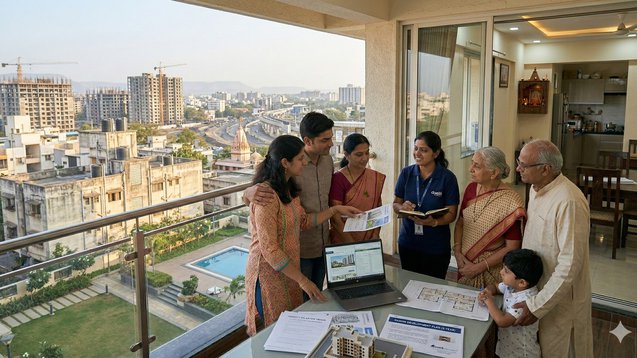
Introduction: Think Beyond Today’s Needs
Home purchasing in India has turned into an emotional process which requires strategic thinking in present times. The property market in Tier 1 cities shows high prices while Tier 2 markets experience rapid infrastructure development and Tier 3 towns witness increasing residential demand. The best homebuyers in this changing market environment use a different approach to determine home purchasing power which they replace with a better question about home suitability five years ahead. The way people think about problems determines their solution path to the problems. People who buy homes today experience a perfect match with their chosen house but to their surprise their needs change when they face different situations which include longer commutes and family expansion and job changes and increased costs and new working patterns. The Indian buying market for homes continues to operate through emotional purchasing which leads to buyers needing upgrades after only two years. A 5-year life planning approach TO your purchase enables you to achieve three goals which include maintaining your lifestyle preferences and protecting your financial assets and keeping your options open for future requirements. This guide assists you if you want to purchase a house in Bengaluru or Lucknow or any Tier 3 town which matches your upcoming life stage instead of your present situation.
Think about where your life's going, not just where you are right now.
Before you start looking at homes, take a step back. Think about what your life will be like in the next five years. This is really important when you are buying a home. You should ask yourself some questions.
Is your job stable?
Will you be switching jobs a lot?
Are you getting it?
Having kids?
Will your parents be moving in with you?
Will you be working from home all the time or sometimes?
In cities like Mumbai, Hyderabad and Gurgaon people often switch jobs. People who work in IT, finance and start-ups often move to a city every 2 to 4 years. So it is an idea to buy a home in a neighbourhood that is easy to get to and has a lot of people looking to rent. This way if you need to move you can easily rent out your home. In cities like Indore or Coimbatore people may not move as much. They may still want to move to a nicer home in the same city. In even smaller cities people usually want to buy a home to live in for a long time. Things like new roads or shops can still make them want to move. When you look at homes on <a href="https://www.propertyaaj.com">Property Aja</a> think about what you will need in the future, not just what is easy now. You should look at homes that will be good for your life in the five years, not just your life today. This will help you find a home that's really right, for you Property Aja can help you with that.
People should decide their location based on their daily needs and requirements instead of judging locations according to their reputation.
Location remains the single biggest lifestyle driver. But here’s where many Indian buyers slip: they choose based on brand value of the area rather than everyday practicality. The distance of 5 to 7 kilometres between locations in Tier 1 cities leads to different levels of commuting challenges. The outer area of the city contains residential units that cost less than the city centre but require people to spend additional time traveling during the week. Tier 2 cities provide extra space for residents but buyers must investigate forthcoming transportation projects which include ring roads and metro systems and IT parks and business districts. The development of Tier 3 towns requires increased attention to both highway access and the readiness of public services and facilities. The best way to conduct this test requires you to create a simulation of your typical weekday activities which you will perform at the selected location. The testing requires you to measure travel times during peak traffic hours instead of Sunday afternoon hours. Smart buyers often use platforms like Property Aja to compare micro-locations side by side before shortlisting site visits.
Buy With One Step of Future Growth in Mind
People who purchase based on current family needs make one of their most expensive errors. The couple who newly wed in Pune purchased a 1BHK home to reduce their expenses. The couple needs to move because their home now feels too small after they established permanent remote work and decided to become parents. The smarter approach? The smart decision requires you to purchase only essential space for your needs. The smart decision requires you to use building designs which provide flexibility through multiple space options. The Tier 1 market advantage becomes stronger because high transaction costs make this strategy more beneficial. The financial impact of frequent upgrades between Tier 2 and Tier 3 cities remains inefficient despite easier access to improvements.
Evaluate Financial Comfort Over Financial Eligibility
Banks may approve a large loan. That doesn’t mean you should take it. Your five-year housing plan must include financial breathing room. Interest rates fluctuate. Job transitions happen. Family expenses grow. An experienced buyer should follow this rule: total housing expenses which include EMI expenses and maintenance costs and tax payments must remain between 30 to 35 percent of their household earnings. In Tier 1 cities, high EMIs are common, so buyers must be extra cautious about over-leverage. Tier 2 buyers often have lower EMIs but should watch income growth assumptions carefully. Tier 3 buyers typically rely more on savings and smaller loans but must still factor future obligations. Your EMI calculation for Property Aja requires you to test your payment capacity under stress conditions which involve interest rate increases between 1 and 2 percent.
Factor in Working, from Home
The pandemic has changed how Indians use their homes for good. In cities where offices are open again many people are still working from home some days a week. This means your home needs to be a place to work, not just relax. In cities people buying homes want: A dedicated study area, room space, Plenty of light and reliable internet. Smaller cities are also starting to see this trend especially among young professionals. Some smaller towns are slowly adopting it. It's not happening everywhere yet. Before you make a decision ask yourself: if I work from home three days a week for five years will this space feel comfortable or too small? Homes that feel comfortable when you work from them tend to stay feeling that way for a time.
Research Infrastructure Growth Instead of Current Development Progress
The appreciation of India's real estate market directly depends on the development of infrastructure projects. The upcoming five years will demonstrate exceptional importance to this matter.
The Tier 1 cities display upcoming metro extension projects which will create new business districts and decongestion corridors.
The Tier 2 cities require establishment of industrial zones and IT parks and ring roads.
The Tier 3 towns need to establish national highway connections and development projects supported by the government.
The first buyers who purchased properties near metro stations in Pune and Ahmedabad experienced both improved living conditions and property value increases. While browsing on Property Aaj, pay attention to growth corridor indicators instead of purely ready, saturated zones.
Don’t Ignore Maintenance and Lifestyle Costs
Many buyers calculate only the purchase price and EMI. But over five years, recurring costs quietly add up. In Tier 1 gated communities, maintenance can range from ₹3 to ₹10 per sq. ft. Premium projects may go even higher. Tier 2 cities generally have lower maintenance but rising trends. Tier 3 towns may have minimal society charges but higher private service costs (tankers, generators, security). Project your monthly outflow realistically for the next five years, including:
Maintenance
Property tax
Parking fees
Society sinking fund
Utility costs
A home that looks affordable today should still feel comfortable after 60 EMIs.
The Legal Safety requirements together with Builder Reliability needs must be established as project requirements.
A five-year plan collapses quickly if the project faces legal or delivery issues. RERA has enhanced transparency throughout India, but different states maintain varying levels of compliance. The oversight quality tends to be superior in Tier 1 markets, while Tier 2 and Tier 3 cities need additional monitoring efforts. Always verify: RERA registration Title clarity Approved building plans Occupancy certificate (for ready homes) State-specific stamp duty rates. Stamp duty differences across states can significantly affect your upfront budget, especially in Maharashtra, Karnataka, and Uttar Pradesh. You must perform independent verification work which should not be skipped.
The process of human decision-making requires examination of exit possibilities which must be evaluated as permanent organizational commitments.
The unpredictable nature of life prevents people from following established life pathways. Your plans will be disrupted by job transfers and business changes and family obligations. Your property needs to maintain reasonable value for resale and rental purposes. The rental market in Tier 1 cities provides better rental opportunities which exist especially near IT hubs and metro line corridors. Tier 2 cities can achieve strong performance in university areas and hospital zones and industrial areas. The demand in Tier 3 towns develops at a slower pace yet those towns still deliver consistent customer requirements. Select a micro market which generates natural demand instead of relying on speculative activities. This gives you a safety net if your five-year plan evolves unexpectedly.
Visit the Property Like Your Future Self Lives There
Site visits should be more than checking out a sample flat. Go there times and see how it is:
During weekday rush hour
Late at night
On weekends
When parking
How water supply works
In cities this helps you find traffic problems. In cities it shows you if the neighbourhood is good at night. Many people who have bought homes before say that the second visit is when they really understood what they were getting into. Think of your visit, like a test run of your life not just a quick look around.
Conclusion: A Smart Home Decision Looks Five Years Ahead
The current process of selecting homes in India requires complete assessment of personal requirements combined with financial capacity and available house features. The process requires the person to complete two tasks which involve evaluating their actual situation and creating future projections. You achieve better purchasing results when you connect your buying decision with your anticipated life path during the next five years which includes career changes and family expansion and financial security and infrastructure progress. The buying process functions the same way in all markets because customers should purchase items that fulfil their actual needs instead of selecting products based on their attractive marketing materials. You should take enough time to conduct an in-depth location assessment while you perform financial testing and you should make flexibility your main focus. The website Property Aja enables users to compare different projects and micro-markets through its reliable platform. The ideal home buying choice consists of a property which creates lasting positive impacts throughout your life instead of a house which creates immediate impressive results.
FAQs
1. What makes a five-year plan necessary for purchasing a house in India?
The five-year period shows all important life developments which include job changes and family growth and financial transitions. Buyers who use this time frame for their planning needs will successfully achieve their goal of purchasing a house without incurring financial distress from unnecessary upgrades.
2. Which aspect should I give more importance to between property size and location?
Location needs to take priority for most situations. The smaller house which exists in a well-connected micro-market area provides residents with better lifestyle advantages and resale potential than the bigger house which exists in a distant location.
3. What percentage of my income should I allocate for my mortgage payments?
The ideal situation requires total housing costs to remain between 30 percent and 35 percent of your total household earnings. The system provides financial security by protecting against interest rate increases and income changes.
4. Do Tier 2 cities provide a profitable investment opportunity for extended periods?
Yes, multiple Tier 2 cities display high housing affordability combined with growing infrastructure development. Buyers need to check three factors which include the job market situation and available transportation options and the local housing market needs before they make a purchase decision.
5. How essential is RERA verification in modern times?
RERA verification serves an essential function. It protects buyers from project delays while maintaining transparency and proving the developer’s legal compliance. The state RERA portal requires users to perform verification activities.
6. Which solution works best when my employment demands me to move to a new location after a short period of time?
You should choose properties which exist in locations with high rental needs and good transportation options. The property generates rental income during your absence which helps to safeguard your financial interests.
Read more about property matters with our specialists and browse the latest property listings on Property Aaj. Download the app from the Play Store and App Store now for easy buying, selling, and renting!